Sunday, October 5, 2008

The 2008 Bay Area UFO Expo – San Francisco

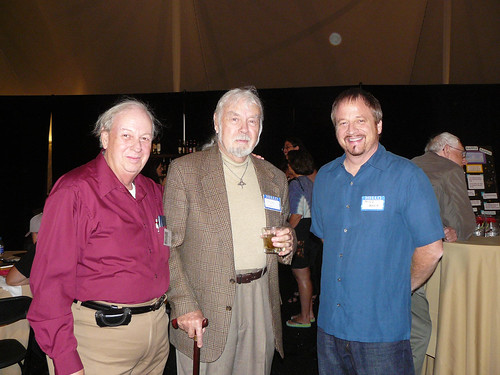
With Clifford Stone and Robert O. Dean


Late Thursday night (the 26th of September), I was sitting around contemplating my plans for the weekend when I got an email from Victoria Jack, who runs the Bay Area UFO Expo and has for 10 years now. For those of you who don't know, the BAUFOE is pretty much the biggest of its kind, at least in this country, and it always has a stellar line up of the top names in UFOlogy. This year was no exception, with the likes of Whitley Streiber, Jordan Maxwell, Robert O. Dean, David Icke, Jose Escamilla, Dr. Roger Leir, Sean David Morton and a whole host of others scheduled to be in attendance. I was surprised to find that the email asked if I was available to fill a lecture spot on Saturday morning, and even though it meant taking the Friday off of my day job (oh the pain, the pain) I readily accepted. I threw together some clothes, slapped a presentation together and headed up the road to Frisco.


With David Icke. I was not drunk. Really.


I can't say enough about everyone I saw there. Contrary to what I have heard over the years, I have found the "UFO community" to be extremely welcoming and open to me in my visits to these events. I met David Icke at the Friday meet and greet, and then rekindled acquaintances with Dr. Leir, Jose, Paola Harris, and a whole host of others. I got up Saturday and hit my lecture right on time, following the excellent presentation by Dr. John Alexander. Like him, I had video issues ($%&*!!! Vista!) and after getting a late start, I managed to get through all my 100 or so slides in the allotted 45 minutes. I was gratified by the reaction of the audience but frustrated with the limitations of the equipment. I learned that some things are just too subtle for the standard 1024x768 projector to handle.


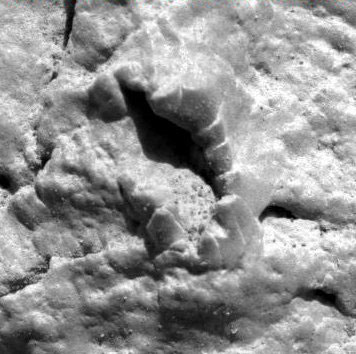
Trust me, its artificial


After that, it was time to relax and I spent some time listening to Jordan, who I just love. And then I went to see Robert O. Dean. I had met Mr. Dean earlier in the day, and I was overwhelmed by his kindness, generosity and graciousness. I honestly don't remember ever meeting a more polite, friendly and engaging man, and I was flattered beyond belief that he had read Dark Mission and not only enjoyed it, but bought copies for several acquaintances that work at the Pentagon. Later, in both his lecture and his workshop, he made special effort to acknowledge me, Richard and Dark Mission, and I was very humbled and grateful for it. Between he and Jordan, who is always so much nicer to me than he ever needs to be, I feel like I am under the wing of 2 Jedi Masters or something. It's not like Richard is chopped liver or anything, but to be blessed by Jordan and acknowledged by Bob Dean feels like way more praise than I ever deserve. I consider all three men to be true giants amongst us, and they've made me feel as though I belonged with them at their side.
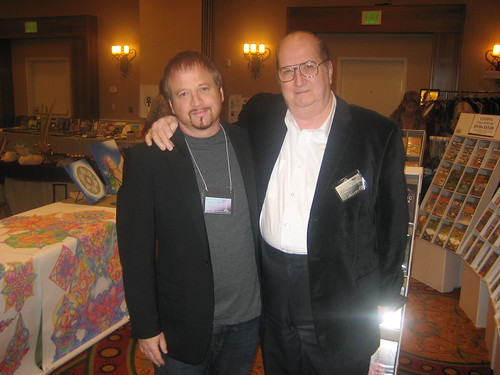


With Jordan Maxwell


I'm not worthy!

The more I listen to Mr. Dean, who has struggled and suffered for what he has told the world, the more impressed I am by the man. It is such a pleasure to hear from someone who has truly glimpsed the future, and feels so optimistic about our place in it. The UFO culture can be a dark and pessimistic place at times, so Bob Dean is a breath of fresh air in more ways than one.


George and TD


After that I headed to Gorge Noory's meet and greet, and once again I was flattered when he spotted me and acknowledged me to the crowd. He is another nice and generous man. It was too bad he and TD (touchdown Tommy Danheiser) couldn't stay, but they had to catch a plane to St. Louis to get George's studio in order after Hurricane Ike (not Icke). Tom and I exchanged a quick hello and he is so helpful and supportive to George. It's really cool to watch.

Saturday night was the big banquet, and I had a table with my name on it and a few people actually sat with me just to talk about Dark Mission. The drinks were strong, Sean David Morton was hysterical as the after dinner entertainment, and the food was excellent. I ended up in the bar (as usual) with Jose, Sean, Jordan, and some new friends over the course of the evening. Jordan held court in the lobby until the wee hours of the morning, and I staggered off to bed happy drunk and truly overwhelmed at how nice everyone is to me.

Sunday I did an interview with Regina Meredith of the Conscious Media Network and went to Paola Harris' workshop. She's as sweet as they come and a very sharp researcher. I also had a chance to catch up with Jordan as well as Tim Crawford. I also had a chance to conspire with several big names about a special project for Richard's next birthday (heh heh heh). I came back from my interview in the lobby to see various people pointing up to the sky, which could only mean one thing: "They" were making an appearance. I ran into Jordan and he told me to go check it out, so Victoria and I both went out to see what was going on. Of course, Whitley's friends had left by the time I got there. Maybe someday I'll see a UFO.

I was sorely tempted to stick around one more night for the speakers' party, but duty and my day job as a card carrying member of the Military Industrial Complex called, so I hit the road about 3 PM and got home to a very unhappy tuxedo kitty.

I had a fantastic weekend and now I'm looking forward to David Icke this week in LA. I assume it's going to rock as much as the rest of my life has been lately. Special thanks to Victoria for inviting me, Robert Perala, Jordan, Bob Dean, Jose, Sean, Brenda, Paola, Melinda Leslie, Roger Leir, George and TD, and pretty much everybody else. I had a blast. Too bad life can't be that much fun all the time.

As always, there are tons more pics over at my Flickr site.

Tuesday, September 30, 2008

Friday, September 26, 2008

Mike Bara to Appear at Bay Area UFO Expo This Weekend

I’ll be appearing this weekend at the Bay Area UFO Expo in San Francisco. I’m giving a 45 minute lecture called “Artificial Structures on the Moon” on Saturday morning at 11:30 AM. If you are in the bay area drop by and I’ll sign your copy of Dark Mission, or just say hi.

Mike

Thursday, September 18, 2008

Extrasolar Planet Image Boosts Fission Model of Planetary Formation


As you may know, an image of the first confirmed extrasolar planet ever photographed was released on Monday of this week. Unlike previously photographed Exoplanets, this one appears to have a mass less than the 13 Jupiter masses which is the accepted limit for planetary designation. At only 8 Jupiter masses, the new planet is well under the mass that would place it in the Brown Dwarf category. Although the newly discovered planet is the right size to be a Brown Dwarf, this low mass implies that it is not.

University of Toronto researchers managed to snap a near infrared image of the gas giant planet orbiting more than 330 AU's from its parent star, 1RXS J160929.1-210524. Both objects are about 500 light years away.

This incredible orbital distance, which calculates to an orbit of some 6,000 years, is a direct contradiction to the accretion theory of planetary formation. The star itself is thought to be only about 5 million years old, the blink of eye in astrophysical terms, and the mere presence of the gas giant world creates all sorts of problems for the conventional model.


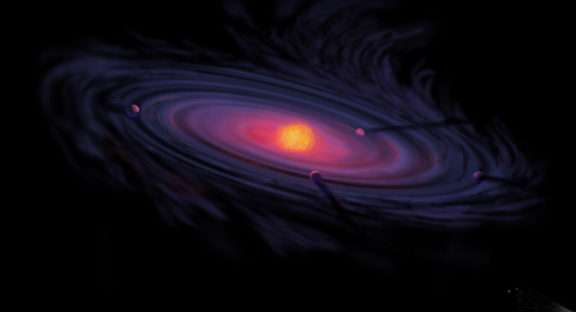
According to current theories, planets form from the remnants of stellar nebula's in so-called proto-planatary disks. However, according to current understanding of this theory, large gaseous planets (or planets of any kind) cannot form at this distance from stars because there is unlikely to be sufficient rocky material to form a mass large enough to collapse into a planet. Instead, scientists are now scrambling to explain how such a young, hot companion could have found itself so far from its parent star, and apparently in a stable orbit. The current theory du-jour is that it was somehow magically flung away from the star by an encounter with another star or due to collisions within the accretion disk. Unfortunately, there is no observational evidence or computer modeling to support this assertion. A better explanation is that the planetary accretion model is simply wrong.

Fortunately for the truly curious, there is a second competing theory of planetary formation that is supported by all of the existing observational evidence – including the discovery of the gas giant 330 AU from 1RXS J160929.1-210524. Some scientists, like Dr. Tom van Flandern, have long argued for the solar fission model of planetary formation.

Click here for video

In the fission model, once the rapidly coalescing solar nebula collapses and achieves sufficient density to begin nuclear fusion, it soon begins spinning so fast that the centrifugal forces become stronger than the gravitational field of the star, and solar material is flung out from the equatorial region of the young star. This material then spirals outward in twin pairs, forming first gas giant planets and then later terrestrial or rocky planets as the star’s angular momentum dissipates. This theory, unlike the solar accretion theory, neatly fits most, if not all, planetary observational data.

The solar fission theory would explain why all the planets are in the so-called plane of the ecliptic, why the planets hold 98% of the total solar system angular momentum but just a fraction (0.002) of the mass, why all of the planets have prograde orbits (matching the prograde spin of the sun), why other extrasolar gas giants seem to have formed so close to their parent stars, and why the planets in our own solar system seem to have formed in relatively similar pairs (Earth and Venus, Mercury and the Moon, Jupiter and Saturn, Uranus and Neptune).

There are naturally objections to the twin pair concept, notably that there is as yet little evidence that Mercury was once a moon of Venus, and that Jupiter is more massive than Saturn (in the twin pairs model it should be the other way around), and that Mars does not fit this model at all. However, in the Exploded Planet Hypothesis, all of this is easily explained, and not by some fairy-tale, move-the-goalposts band aid, but by actual observational evidence.

Our own Mars Tidal Model proves, with one simple correlative observation, that Mars has tidal bulges. The mere existence of these tidal bulges where none should exist is De facto proof that Mars is not a planet at all, but rather a moon of a much larger planet (designated “Planet V” in the EPH) that once existed near the orbit that Mars now occupies. It also implies - if the solar fission model is correct - that there is a missing “twin” of Planet V somewhere out there in the solar system.

OK, so where is it?

The EPH also builds on the idea of the old Titius-Bode law of planetary spacing. Roughly stated, TB says that each successive planet is about twice as far from the sun as the previous planet. Using the following chart, this all works out pretty well for the most part:


As you can see, until we get to Neptune, the TB Rule works almost perfectly. Only at the far reaches of the Solar system do we begin to see significant deviation. The following chart illustrates the point succinctly:


The only exceptions here are Ceres, which is not a planet but rather a prominent body in the asteroid belt between Mars and Jupiter, and Neptune, which seems pretty far out of the margin we would expect if TB was correct. Neptune is dealt with in van Flandern’s book Dark Matter, Missing Planets and New Comets, so we won’t get into that here. The main point is that according to the EPH, there are at least two missing planets in our solar system, Planet V, the parent planet of Mars, and Planet K, which once existed in the orbit now occupied by the asteroid belt. They would most likely have been terrestrial pairs, similar to Earth and Venus but with much larger masses and planetary radii.

So the asteroid belt turns out to be where Planet K once roamed, accounting for the multitude of bodies in that rocky ring of planetesimals. The EPH also explains one other enduring mystery of the solar system – why Mars and Mercury have the two most eccentric orbits of all the “planets.”

If, as the EPH postulates, Mars was once a moon of Planet V and Mercury a moon of Venus, then it would stand to reason that they, having been recently ejected some 65 MYA, would have non-circular or “eccentric” orbits. This is in fact exactly what we see. Mercury (0.206) and Mars (0.093) have by far the most elliptical orbits of any of the major planetary bodies.

So what does all this have to do with the newly discovered gas giant around 1RXS J160929.1-210524? Well, it seems obvious that we are seeing, in near real time, the birth of a new planet in accordance with the fission model. It has been ejected from its parent star a relatively short time ago, and is already some 330 AU from its birth place. Not only does this tell us that planets can exist that far from a parent star (which greatly increases the likelihood that a Planet X exists in our own solar system), but it also explains how massive gas giants can be found so close to their parent stars, as has been observed in some other cases. It’s obvious that these close-in gassy planets have only been recently excreted from their parent stars.


It should be a fairly easy task to calculate its rate of recession from 1RXS J160929.1-210524 (let’s just call it 1RXS from now on, shall we?) - if it is receding at all - and determine (based on its luminosity) how long it has been traveling away from 1RXS. That will give us a timetable for about how long it should take a star of similar mass and composition to start spitting out planets and give us a fighting chance of training our cameras on another candidate star and perhaps catch it in the act of spewing out its first planet.

And wouldn’t that be a picture?

Wednesday, September 17, 2008

Tuesday, September 16, 2008

Extraordinary!


I couldn't believe it when I saw it, the first real proof that there are other worlds orbiting distant stars. University of Toronto researchers managed to snap an image of a gas giant planet orbiting more than 330 AU's from it's parent star, 1RXS J160929.1-210524. Both objects are about 500 light years away.

There are tons of implications of this discovery, but for the moment, I just want to sit back and wonder at something I never thought I would ever see.

Another world. In a completely different star system.

Amazing.

Saturday, September 13, 2008

Quick Blogging Update

You guys may have noticed that the pace has slowed here in the last few weeks. There are several reasons for this, most notably that I am spending more time on my NFL Football Blog and a new political Blog that I felt compelled to start. I'll be posting to that one with some frequency, at least through the election cycle. I'm also working on the last 5,000 words for a new book I'm doing solo, and then I have some more writing to do for another project with Richard. These have hard deadlines of October 1st and November 1st respectively, and I have a few other projects which deserve my attention as well. And there is always my day job as a card carrying member of the military industrial complex.

The point is, I'm going to back off the Dark Mission Blog for a while. I am by no means abandoning this blog, I'm just going to be adding new stuff with less frequency until I can clear some other items from my to do list. There are a couple of upcoming posts, including another research paper documenting a Hyperdimensional physics effect, and some thoughts on the rumor that NASA may be preparing to release "proof" of life on Mars. These will likely appear next week at some point, and as always I'm ready to post on any breaking news.

I just wanted to let you guys know what was going on.

Mike