Wednesday, February 20, 2008

A Hyperdimensional SDI Test?


Later today, at approximately 10:30 PM Eastern time (3:30 AM Universal), the United States Navy will (weather permitting) attempt to shoot down a US spy satellite using a modified sea launched SM-3 missile. The three-stage, solid-fuel Raytheon missile will be launched from a from a Ticonderoga class Aegis cruiser some 600 miles west of Hawaii. The Navy has decided to take this rather drastic action because the satellite, dubbed USA-193 for purposes of the shoot down (its real designation is apparently classified) contains a fuel cell full of hydrazine, a volatile and potentially hazardous chemical that could cause sickness or even death to humans if they were exposed to it upon re-entry. By destroying the satellite in space north of Hawaii, the hydrazine will be harmlessly released in orbit, and the resulting satellite debris likely scattered harmlessly over the northern Pacific Ocean and remote areas of Canada and West Africa, greatly reducing the chances of exposing populated areas to low altitude hydrazine residue.

At least, that’s the publicly stated reason.

There is, naturally, a degree of skepticism about this whole plan from the usual cold war suspects. Russia, led by former KGB officer Vladimir Putin, has speculated that this shoot down proposal is just a convenient excuse for an “off-budget” SDI test. Under this scenario, Washington would be using the obsolete satellite as target practice for a live fire exercise of new guidance technology developed under the SDI program. This notion is supported by the fact that the missiles to be used (there are three missiles and three launch windows over the next several days) are to be launched without explosive warheads. The Navy plan actually calls for a fully ballistic intercept (at over 22,000 MPH). Not only that, but the objective is to not just hit the satellite (which is as big as a school bus) but to pierce the spacecraft’s fuel tank specifically. A public demonstration of such technological proficiency would undeniably change the balance of Anti Ballistic Missile power greatly in favor of the US.

By using the hydrazine contamination as an excuse, this technological demonstration can be conducted without the international diplomatic complications that a similar -- though fully acknowledged -- SDI test would bring. Democrats in congress have always opposed any deployment or testing of SDI hardware, preferring (for reasons we find unfathomable) to leave the US naked to a ballistic missile attack. It is unlikely they would support such a test if it was openly acknowledged as such by the Administration. Further, it would be very hard for subsequent administrations to abandon a system which had proven its superiority to such an impressive extent.


We here at Enterprise always have a slightly different read on such mundane matters, of course. What caught our eye were not so much the real-world political implications of this technological muscle flexing, but rather the strange and ritualistic pattern under which it was being carried out.

Those of you who have read our current book, “Dark Mission – The Secret History of NASA,” are certainly aware of the constant repetition by that Agency of the ritual numbers “19.5” and “33.” As we repeatedly document in “Dark Mission,” over and over again we see these numbers inexplicably expressed in the landing site coordinates of innumerable NASA planetary missions, over the last half century; in the positions of certain key “ritual stars” over these planetary landing sites; and even in the timing of Cape Canaveral NASA launches, landings, and other key mission events – both manned and unmanned.

So we knew “something” interesting was happening, when we saw the location and time of the launch of the first SM-3 Missile.

Under the ideal circumstance, the launch will take place at 3:30 AM Universal time from somewhere very near 19.5 degrees latitude. In fact, in what senior military officials acknowledge is a highly unusual move, Defense Secretary Robert Gates will “just happen” to be in the area, in Hawaii, at the official Navy Command Center, at 19.5 degrees. And, in a most unusual command decision, the Secretary -- not the Captain of the Aegis cruiser Lake Erie -- will be the one giving the firing orders from the Hawaiian Command Center -- personally.

Oh and by the way -- all of this will be taking place during a total Lunar Eclipse.


Although we don’t yet know exactly what is going on here, we can say this:
There are just too many “Hyperdimensional coincidences” around this event for our comfort. While we don’t know what yet, we suspect something pretty spectacular is going to take place when and if the shoot down actually happens.

Stay Tuned.


Update 7:30 PM Pacific

We received this communication earlier this evening, from a source we’ll just call “very reliable.”


“Today [February 20, 2008], there were several escorted military caravans coming through Socorro [New Mexico]. I witnessed two of them: one at noon, the other about 2:45pm. They turned off I-25 at San Antonio for the Stallion Gate at White Sands. Many were trailers about the size of a semi-truck trailer, painted plain sand color, only a few with desert (Iraqi) camouflage. Quite a few of them were clearly large generators. Additionally, there were a few large diesel generators on flat bed trucks. Others had weird assortments of metal work, covered with tarp hinting at long metal poles and "Rohn tower" sections. A few other trailers had the appearance of a field command center thing, and a couple clearly communications trailers. Of course, everything had the 6-8 foot long whip antennas. I assume they were coming down from Kirtland in ABQ. Also, some flatbeds carrying 2 Hummers each, and other trailers carrying several smaller dune-buggy type vehicles, which I noticed said SCORPION on the back.

“The one I saw at 2:45pm pulled into the Lemitar truck stop. I followed. The military personnel, all in desert cammo gear, took turns entering the truck stop for refreshments ... that is, no vehicle was left unattended - one guy taking a turn, then the next. Several wore side arms, but they did not enter the store.

“I've seen military caravans through Socorro before, but never caravans of this size (or seriousness) since the landing of the space shuttle many years ago. Those did NOT enter White Sands at the Stallion (north) gate.

“There's always been local rumors how they built a massive laser weapon at White Sands, capable of taking something out of orbit. I know for a fact construction was begun as part of Reagan's star wars initiative, but supposedly 1/2 through construction, it was scrapped. Few around here believe that, and built at White Sands in conjunction with the GEODDS satellite tracking network (now called something else).

“There is a mysterious phenomenon at White Sands. Every few months, you will see MILES of strobe lights illuminated, running north-south (maybe 20-30 miles long) in two perfectly straight lines, maybe 20 miles apart. They illuminate these lights every few months late at night. They are not visible from I-25 (except a few miles around San Marcial), but very visible farther east of the Rio Grande, like along US 380. They blink in sequence running north to south, as if painting a huge runway. Some say it is to alert military pilots to stay out of the airspace when they are testing the laser weapon. Regardless, it is illuminated tonight, the first time I have seen it on since mid December.

“Sorry for rambling, but the point is, makes you wonder if some secret weapon at White Sands isn't being mobilized as a backup for tomorrow's shoot down.”

Of course, anyone who has read “Dark Mission” knows that the White Sands Missile Range is located at 33 degrees North latitude -- a ritual location of the same type outlined in our earlier post. It initially occurred to us that the missile test in Hawaii might be just a cover story for a real, covert weapons test … being conducted from White Sands. However, one look at the orbital plots told us that there was no way a laser or particle-type beam weapon could get a clean shot at USA-193 -- at least not on the current orbital trajectory, and in tonight’s “window.” They did have such a window several hours ago, but that has passed. And, it seems likely -- with everyone outside looking at the lunar eclipse -- somebody would have noticed if the satellite had been shot down already.

But, there is one other possibility – back in the early days of SDI, one of the proposals was to shoot a laser off of an orbiting mirror, giving such a weapon a true “over the horizon” capability. It is possible that such a system has been developed and deployed, and is awaiting its first functional test tonight?
We shall see.

Late Word: The NY Times is reporting that the missile successfully struck the satellite.

Update: Here is a link to a video of the USA-193 strike. Pretty impressive. -- MB

Saturday, February 16, 2008

Mike Bara to Appear on Beyond the Paranormal Radio

Mike Bara will appear on Beyond the Paranormal Radio program on on 2\16\2008 on KCAA radio. The show begins at 8PM Pacific. You can listen live on http://www.kcaaradio.com/.

Sunday, January 27, 2008

Richard C. Hoagland to appear on the Mark and Brian Show


Dark Mission co-author Richard C. Hoagland will appear on the Mark and Brian Morning drive time radio program on Tuesday, January 29th 2008 at 7:30 AM. The show is local to the Los Angeles area on KLOS 95.5 FM and syndicated nationally. The program's official website (where you can listen live) is here.

Wednesday, January 23, 2008

Upcoming Appearances

Hi,

Just wanted to drop by and let everyone know that I will be appearing with my co-author, Richard C. Hoagland @ the Conscious Life Expo in Los Angeles, February 9-11, 2008. Richard will be giving two presentations, one on Sunday, Feb. 10th @ 12 noon, and the other on Monday the 11th @ 7PM. Richard and I will be signing books on both days, so if you want to bring your copy of Dark Mission by we'd be glad to sign them for you.

Richard is also appearing in Seattle at the "Psychic Spectrum Expo" at the Double Tree Hotel @ SeaTac Airport on Saturday, Feb. 22nd from 7-9 PM.

I still haven't decided if I'm going to the Seattle event, but it is my hometown and a chance to catch up with family and friends, so I'm leaning that way. It's just that I hate to fly.

Details on all these appearances can be found on Richard's website, enterprisemission.com.

Thursday, January 17, 2008

Revisting the True Colors of Mars


Back in October 2007 we posted a blog entry on the color correction problem NASA has historically had with images taken from the Martian surface. We deal with this specifically in chapter 11 of Dark Mission, and also posted articles on it on the Enterprise Mission web site several years ago.


As we showed in those articles, NASA has deliberately altered the colors of the images to make the Martian sky appear an absurd “Technicolor red,” when in fact all the evidence clearly shows that the true color of the Martian sky is (and must be) blue – just as it is here on Earth. In fact, when we used a simple color correction tool in PhotoShop called the Auto Levels tool, Mars came out looking as Carl Sagan described it after the first Viking images in 1976 – it looked like Arizona.


Now, even though we posted links to the earlier web articles showing the evidence for why Mars skies must be blue and not red, several readers apparently didn’t read those articles and continue to insist either that the color of Mars sky should be red, or that typical auto correction tools are not appropriate for this kind of analysis.

To wit:

“Unfortunately this kind of white balance color correction does not prove anything. It only shows what the Martian landscape would look like on a sunny day under an Earth sky. The only thing we can know for sure about the "corrected" Martian sky in that picture is that it is wrong. Both the color chart and the landscape reflect light, which gets corrected. The sky on the other hand is direct light. The only way to know for sure what NASA has been doing is if we had some direct light source on the rover for which the light spectrum was known … The reason for bringing the color chart to Mars is not to get a corrected picture, but to be able to correct for the Martian light conditions such that the stones can be seen in their true colors as if they had been brought back to Earth. That is a smart thing to do if you have geologists working on classifying the stones. But sorry, this kind of color correction alchemy will never tell us if NASA is fooling us or not.”

And…


“… It would make no sense that the colour of the Martian sky should be blue. The atmosphere on Mars is completely different than the atmosphere on Earth. The light is also traveling a greater distance to reach Mars. I have found the following excerpt on a page which explains, in detail, why the sky is blue on Earth. The page also used Mars as an example to explain why the atmosphere must be the correct composition to result in the bluing of the sky:

“’…Notice that this argument depends very little on the composition of the atmosphere. Any clear atmosphere of more or less Earthlike size and density, lit by a sun whose light appears more or less white, would result in a blue sky.

“’The color pictures from Mars Pathfinder are a spectacular reminder that the sky is not blue on Mars. Instead, it has colors that have been described as everything from "orange-pink" to "gray-tan", as was discovered in the 1970s by the Viking landers. This is because the atmosphere of Mars is very thin and dusty, and atmospheric light scattering is dominated not by the molecules of gas (in the case of Mars, mostly carbon dioxide) but by suspended dust particles. These are larger than the wavelengths of visible light, and they are reddened by iron oxide, like Martian soil. It's not just Rayleigh scattering, so the power spectrum is different…”


There are only three things wrong with these evaluations; they’re wrong, they’re wrong, and they’re wrong.

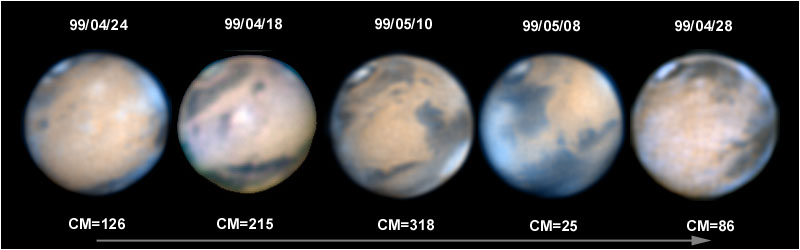
First of all, as we clearly establish in the color article on the Enterprise Mission web site, the atmosphere of Mars is not “dusty” -- at least not all the time. The article contains several earth bound telescopic images as well as Hubble images and one from Mars Global Surveyor which all show that the scattered sunlight from the air glow limb of Mars is categorically blue. You can see them here, here and here. The fact that they are all blue effectively eliminates the “suspended dust” argument as an explanation for why the sky is red on virtually all NASA images taken from the Martian surface. Clearly, if there was optically significant red dust suspended in the atmosphere of Mars on a consistent basis, the repeated orbital and ground based telescopic photography would reflect this. They do not.

Further, as this NASA press release explains, even the planetary scientists at NASA expected the sky to be blue in the Pathfinder images. To quote: "If dust diffuses to the landing site, the sky could turn out to be pink like that seen by Viking ... otherwise Pathfinder will likely show blue sky with bright clouds.” [emphasis added].

We can also discount the presence of this reddish dust as a factor in the red skies of Mars by using another scientific methodology; simply looking at the shadows that are cast.

If there were vast quantities of reddish dust in the sky obscuring the direct sunlight, then the shadows cast by the rocks and hills would have to be diffuse and fuzzy. In fact, if you look at the majority of NASA surface images of Mars, the shadows are distinct and sharp, meaning the sunlight is not being significantly obscured or diffused – either by clouds or the mythical “reddish dust.” This constitutes an absolute, inviolable proof (based on fundamental optical physics) that “red dust” cannot be the reason that Mars skies appear red in so many NASA processed images.

Now, as to the other statement that “The only way to know for sure what NASA has been doing is if we had some direct light source on the rover for which the light spectrum was known …” Well, we have an answer for that one too.

The fact is, we do have a “direct light source on the rover for which the light spectrum is known...”

It’s called the Sun.

Since, as we’ve already established, dust and clouds are not a factor in the rover images we have posted, then the rover itself (and the color chart on it) are being subjected to “direct sunlight.” Since the Sun is a fairly common “G-class star,” its visible light spectrum is well known (see here). So, in the absence of significant diffusion caused by red dust or heavy clouds, we can expect that the surface of Mars will look pretty much like the surface of the Earth under the same direct sunlight. Therefore, using a tool like the auto balance feature in PhotoShop to correct the color chart so that it appears as it did on Earth is a perfectly valid technique, and one which should produce results that accurately reflect what objects on the surface of Mars truly look like.

But you don’t have to take our word for it. We're not the only ones to have reached this scientifically-based conclusion.

Ron Levin is the son of Viking Labeled Release Experiment Principal Investigator, Dr. Gil Levin. The younger Levin is an MIT-graduate physicist, currently working for Lockheed-Martin, who has, independently, carried out his own analysis of the "color anomalies" seen in the NASA rover images. Ron’s story of how he almost got kicked out of JPL in 1976 for correcting the color on the public monitors is told in Dark Mission.

In one recent paper on the NASA surface color imagery, titled "Color Calibration of Spirit and Opportunity Rover Images," Levin writes:

“... images of the [rover] color calibration chart taken on Mars for the express purpose of verifying calibration seem to be in reasonable agreement with calibration images taken on Earth under Earth-like illumination conditions. However, calibration charts shown inadvertently on production panoramic images are not compatible with those images made for the express purpose of calibration [emphasis added] ...."

In other words, NASA is deliberately altering the colors of the Martian surface and sky, as an examination of the color calibration charts shows.

Which is what we’ve been saying all along here.

Levin's detailed color analysis is presented here: http://mars.spherix.com/5555-30.PDF.

So, despite what our posters would like to believe, the “suspended dust argument” simply doesn’t fly (pun intended). The only significant factor in the color of the Martian sky is Rayleigh scattering, no matter what the person quoted in the post above wants to believe.

But what about Mars atmospheric density or composition, as the other poster mentioned? Doesn’t that affect Rayleigh scattering?

In a word; no.

Rayleigh scattering is a phenomenon that is a function of sunlight’s interaction with gas molecules of a given size in a planetary atmosphere. Whether those molecules are oxygen, nitrogen, carbon dioxide or something else (like hydrogen or helium) makes no difference. All these molecules are basically the same size ... and thus will scatter blue light most effectively.

Nor does the “distance from the sun” make a difference in the spectra of light that is emanated from our Sun. The fact is the colors on the surface of Mars should look virtually identical to the colors on the surface of Earth to a human observer, because essentially the same direct sunlight is coming from the same sun and passing through a Rayleigh scattering atmosphere, exactly like it does on Earth. Only the intensity of sunlight on Mars is different because of the increased distance from the sun. The colors -- though the same -- are somewhat dimmer due to this minor decrease in total solar luminosity. But this affect is minimal: most sunny days on Mars are far brighter than an average cloudy day in Seattle, for instance.

And, as Dr. Levin points out in another paper on Mars color image calibration (http://mars.spherix.com/spie2003/SPIE_2003_Color_Paper.htm), there is yet another “proof” that skies on Mars are blue, and not red. The source of this “proof” is also unimpeachable –

It is the Rovers themselves.

As Levin points out in his second paper, the current Mars rovers Spirit and Opportunity (as well as their predecessor, the Pathfinder rover Sojourner), literally carry on their backs all the proof we will ever need that our thesis is correct. It comes in the form of the solar panels on the rovers themselves.

Unlike the earlier Viking landers, which were powered by a radioisotope thermo-electric generators (RTGs) fueled by plutonium – sort of a mini nuclear reactor -- the current generation of Mars explorers get their energy a completely different way. The Sojourner, Spirit and Opportunity rovers are powered by solar cells that convert light from the sun and sky (i.e. both “direct” and “scattered” light sources) into electrical energy. However, this energy conversion is much more efficient in a specific part of the spectral bands that illuminate Mars, the blue and the green. Red light, in fact, is extremely inefficient for this purpose compared to blue and green light, and if the skies on Mars truly as red as indicated by the official NASA photographs, this would have resulted in at least a 25% reduction in energy output from the rovers solar panels. This has not occurred on any of the missions (as determined by both direct telemetry of the minute-by-minute power-generation capabilities of all the rover solar panels, as well as monitoring of their overall power consumption curves).

As a result, we can now safely conclude that the skies on Mars must be predominantly blue, and not red.

We can further surmise that NASA technicians and engineers must certainly have known this well before the rover mission were approved, otherwise they would not have chosen to put solar panels on the rovers at all.
There is one final test which can be applied to prove the accuracy of all our technical assertions on this issue.

As it turns out, the sands of Mars are not red, as NASA has consistently asserted with their laughable color correction. In reality, the real surface of Mars tends to be more of flat yellow-red to salmon color, as many independent color corrections show. We can prove this by simply looking at some images of Mars when there is a lot dust suspended in the atmosphere – like during a major dust storm. When we examine these images, the atmospheric limb changes from a pure Raleigh scattered blue to an intense green (see here). As we all know from our experiences in finger painting in Kindergarten, you only get green by adding yellow to blue. Adding red to blue would produce not green, but purple or violet. So that means that the green scattered limb color is a result of yellowish dust interacting with a predominantly blue Rayleigh-scattered Martian sky.


What this also means is that if NASA’s color images from the surface of Mars were really an accurate reflection of a sky filled with dust, then that sky in virtually all the surface images would tend to be tinted green, not “Technicolor red.” Now, has anybody seen an official NASA Rover image with diffuse shadows and a green tinted sky, like a scene out of Forbidden Planet? If so, we’d like to see it.

So not only is our color correction technique scientifically valid, it is just one of many proofs reinforcing our most critical underlying assumption…

NASA lies.

Tuesday, January 15, 2008

Mike Bara on Shadows in the Dark Radio


Dark Mission co-author Mike Bara will appear on the Shadows in the Dark internet radio program on Thursday, January 17th, 2008 at 10PM Eastern, 7 PM Pacific.

(www.shadowsinthedarkradio.com)

Friday, January 11, 2008

Dark Mission co-author Richard C. Hoagland will appear on the Dennis Miller Radio show Monday, January 14th, 2008


Dark Mission co-author Richard C. Hoagland will appear on the Dennis Miller radio program on Monday, January 14th. The Dennis Miller program runs from 10AM to 1PM Eastern time Monday thru Friday. The program's official web site is here.